 ESPCI web site



phd offer
ESPCI PSL, Paris, France (Soft Matter Science and Engineering Laboratory (SIMM) & Institute of Porous Materials of Paris (IMAP))
Supervisors Jean Comtet —  · blog.espci.fr/jcomtet
Loïc Assaud —  · blog.espci.fr/assaud
Keywords : Solid/liquid interfaces · Nanobubbles · Electrocatalysis · Energy · Hydrogen
Start date : March 2027
Application deadline : October 31, 2026 (through the PRISM COFUND doctoral programme)
SPECIFIC APPLICATION RULES
Candidates must comply with EU mobility rules : they must not have resided or carried out their main activity (work, studies) in France for more than 12 months in the 36 months immediately before the call deadline (end of October). There is no nationality restriction — researchers of any nationality can be recruited, provided they satisfy the mobility rule. Candidates must hold a Master’s degree or equivalent at the time of application.
An internship position on the same topic is available in fall 2026.
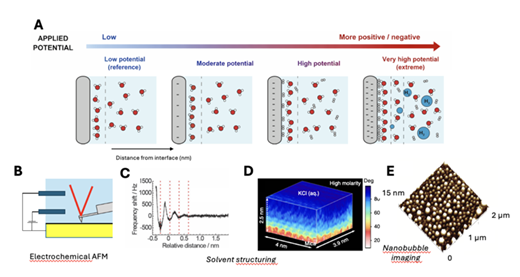
Figure — (A) Evolution of the interfacial state with respect to the applied electrode potential, transitioning from interfacial solvent restructuring, H₂ physisorption, up to hydrogen bubble nucleation. (B) Scheme of the electrochemical AFM setup. (C-D) Imaging of solvent structuring in 1D [3] and 3D [4]. (E) Mapping and imaging of surface nanobubbles [2].
Description of the PhD project
The transition toward sustainable energy systems critically relies on the development of efficient water electrolysis technologies for green hydrogen production. However, the performance of electrolyzers is strongly limited by the formation, growth, and adhesion of gas bubbles at electrode surfaces, which block active sites, increase local resistance, and alter mass transport near the interface. Despite extensive studies, the fundamental mechanisms governing the earliest stages of bubble nucleation, occurring at the nanometric scale, remain poorly understood due to the lack of suitable in situ characterization techniques.
This PhD proposal aims to address this major knowledge gap by developing an innovative experimental approach combining electrochemical control with in situ Atomic Force Microscopy (AFM) in liquid environments. Building on recent advances and the installation of a new electrochemical AFM platform within the ESPCI premises, the project will provide unprecedented access to molecular-scale processes occurring at electrode/electrolyte interfaces during water electrolysis. In particular, it seeks to elucidate the transition from solvent restructuring under applied potential to gas supersaturation and ultimately nanobubble nucleation (Fig. A).
The scientific rationale rests on the hypothesis that bubble nucleation is a metastable process governed by a subtle interplay between local surface properties (chemistry, wettability, roughness, defects) and electrochemical conditions. To get novel fundamental insights into this process, we will first focus on model electrodes (e.g., graphite). We will rely on high-speed and high-resolution dynamic force spectroscopy of near-surface structural and solvation forces (Figs. C-D), which will provide insight into the early stages of bubble nucleation — from solvent restructuring under electrochemical potential, to interfacial gas saturation, to bubble nucleation and growth kinetics (Fig. A). We will then extend our investigations towards more realistic electrodes, using high-resolution imaging of surface nanobubbles (Fig. E) to correlate local bubble nucleation with surface chemistry (hydrophilicity/hydrophobicity balance), topography, and defects. Together, these measurements will help identify nucleation pathways and clarify the role of surface heterogeneities in triggering bubble formation.
A second objective will then be to establish quantitative correlations between these nanoscale observations and macroscopic electrochemical performance. By systematically varying electrode materials and surface treatments, we will aim to determine how local interfacial phenomena influence global efficiency, thereby providing guidelines for the rational design of improved electrodes with reduced bubble-related losses.
Overall, this PhD project is highly innovative in its ability to access previously inaccessible interfacial phenomena at the nanoscale and to bridge the gap between interfacial soft matter, solid/liquid interfaces, fundamental surface science and applied electrochemical engineering. Its expected outcomes will contribute to both fundamental understanding and technological advances in hydrogen production, positioning it at the forefront of research on energy-related interfacial processes.
Requirements
We are looking for a master’s student with a background in physics, materials science, electrochemistry, or physical chemistry, who is excited to dive into an interdisciplinary project at the crossroads of soft matter, interfacial physics and physico-chemistry, liquid-state physics, electrochemistry, and electrocatalysis. The envisioned AFM experiments are technically demanding and require great care and precision : a strong aptitude for hands-on experimental work with complex, custom-built instruments — here, Atomic Force Microscopy — together with solid data analysis skills, will be key to making the most of this project. Beyond technical background, we are above all looking for someone curious, open-minded, and able to think independently, who is eager to take ownership of a research question at the frontier of physics and electrochemistry.
Project team
The project team brings together complementary expertise from two researchers, J. Comtet and L. Assaud, based in two ESPCI research units : the Soft Matter Science and Engineering Laboratory (SIMM) and the Institute of Porous Materials of Paris (IMAP). J. Comtet’s research focuses on probing the transport and dynamics of soft matter at interfaces, at the nano- and molecular scale, using innovative experimental approaches ranging from scanning probe to single-molecule imaging. L. Assaud’s work centers on the characterization and optimization of novel two-dimensional electrochemical interfaces and electrocatalytic processes through nanostructuration.
This project is thus unique in bringing together complementary expertise in electrochemistry (IMAP), wetting and solid/liquid interfaces (SIMM), and quantitative scanning probe microscopy (IMAP, SIMM). By combining in situ electrochemical AFM with systematic surface engineering to directly observe the nucleation and early growth of gas bubbles at the nanoscale, this approach will enable the exploration of interfacial material properties at the nanometric scales, and open new avenues for the design of highly efficient electrodes for water electrolysis.
References
[1] Kempler, P. A., Coridan, R. H., & Luo, L. (2024). Gas evolution in water electrolysis. Chemical Reviews, 124(19), 10964-11007.
[2] Zhang, L., Zhang, Y., Zhang, X., Li, Z., Shen, G., Ye, M., … & Hu, J. (2006). Electrochemically controlled formation and growth of hydrogen nanobubbles. Langmuir, 22(19), 8109-8113.
[3] Utsunomiya, T., Yokota, Y., Enoki, T., & Fukui, K. I. (2014). Potential-dependent hydration structures at aqueous solution/graphite interfaces by electrochemical frequency modulation atomic force microscopy. Chemical Communications, 50(98), 15537-15540.
[4] Martin-Jimenez, D., Chacon, E., Tarazona, P., & Garcia, R. (2016). Atomically resolved three-dimensional structures of electrolyte aqueous solutions near a solid surface. Nature Communications, 7(1), 12164.
[5] Comtet, J., et al. (2017). Nanoscale capillary freezing of ionic liquids confined between metallic interfaces and the role of electronic screening. Nature Materials, 16(6), 634-639.

- Download the document