 ESPCI web site



Internship proposal
Laboratoire Sciences et Ingénierie de la Matière Molle, (SIMM)
Address: ESPCI, 10 Rue Vauquelin 75005 Paris
Head: Jean-Baptiste d’Espinose
Supervisors: Jean Comtet
Contact :  https://blog.espci.fr/jcomtet/
Internship with possibility for extension as a PhD
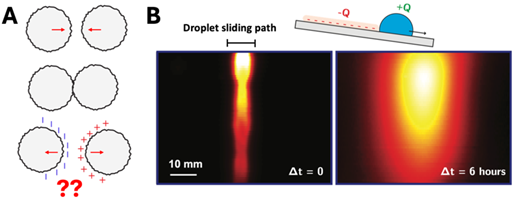
Figure. (A) Schematic of solid triboelectrification following contact between two solid particles, leading to charge separation. (B) Electrostatic surface potential mapping following triboelectrification by sliding liquid droplet, showing that surface deposited charges diffuse laterally at a very high rate [5]
The well-known triboelectric effect refers to the charging of solid surfaces upon mechanical contact. This ubiquitous phenomenon has macroscopic consequences, ranging from the mundane to the fundamental (e.g., tribocharging promotes dust aggregation, which may have played a key role in the early stages of planet formation [1]). More recently, triboelectricity has attracted renewed interest for the development of novel energy-harvesting devices with exceptional performance [2]. However, the origin of this surface charging remains poorly understood, and has been variously attributed to the transfer of minute quantities of electrons, ions or material between surfaces [3].
Interestingly, water - through the exchange of protons and hydroxide ions - has been put forward as a potential key player in electrification, an exciting hypothesis that we aim to test [4]. The aim of this internship is to explore the fundamentals of solid triboelectrification, building on two complementary approaches currently being developed in the group.
1) Spatio-temporal charge mapping. We recently demonstrated the ability to map the spatial distribution and temporal evolution of surface charges deposited during liquid triboelectrification, in which charge separation occurs as droplets slide on hydrophobic surfaces [5]. This spatio-temporal mapping allowed us to reveal spatially heterogeneous charging patterns as well as an unexpectedly high mobility of surface-trapped charges, providing new insight into their physicochemical nature. We will extend this approach to solid triboelectrification between insulating dielectric materials. By combining well-controlled tribological conditions with spatially and temporally resolved mapping of the deposited surface charges, we will seek to relate in a quantitative manner local frictional processes to surface electrification.
2) Nanometer-resolved surface force measurements. Building upon our strong expertise in Atomic Force Microscopy (AFM)-based techniques [6], we will characterize the local interactions at play as two particles come into and out of contact. By resolving surfaces forces such as capillary condensation due to water exchange, or long-range electrostatic forces induced by charging, we will obtain novel insights into the elementary processes at play during contact electrification.
Overall, we hope to gain new insight into these poorly understood electrification processes, with both fundamental and practical implications.
We are looking for a student strongly motivated by experimental work involving custom-made setup and with a strong background in physics or physicochemistry. This internship could be followed by a PhD.
[1] T. Steinpilz et al., “Electrical charging overcomes the bouncing barrier in planet formation,” Nature Physics, vol. 16, no. 2, pp. 225–229 (2020)
[2] W. Xu et al., “A droplet-based electricity generator with high instantaneous power density,” Nature, vol. 578, no. 7795, pp. 392–396 (2020)
[3] D. J. Lacks and T. Shinbrot, “Long-standing and unresolved issues in triboelectric charging,” Nature Reviews Chemistry, vol. 3, pp. 465–476 (2019)
[4] G. M. Whitesides. "Ionic electrets: electrostatic charging of surfaces by transferring mobile ions upon contact." Journal of the American Chemical Society 129.13: 4075-4088 (2007).
[5] J. Comtet et al., “Giant mobility of surface-trapped ionic charges following liquid tribocharging,” Proceedings of the National Academy of Sciences, vol. 122, no. 37, e2505841122 (2025)
[6] J. Comtet et al., “Atomic rheology of gold nanojunctions,” Nature, vol. 569, no. 7756, pp. 393–397 (2019)

- Download the document