 ESPCI web site



Proposition de stage
Laboratoire Sciences et Ingénierie de la Matière Molle, (SIMM)
Adresse : ESPCI, 10 Rue Vauquelin 75005 Paris
Directeur du laboratoire : Jean-Baptiste d’Espinose
Responsables du projet : Dehlia Gamra, Jean Comtet, Costantino Creton
Duration : 5-6 months.
Beginning : autumn 2026.
Missions : conduct wear experiments, analyze data (using ImageJ, MATLAB, …), draft reports and present results during team meetings.
Student profile : highly motivated Master’s (M1/M2) or engineering school students interested in this interdisciplinary internship, which combines material chemistry, soft matter physics, mechanics, and optics with autonomy and scientific curiosity. Prior experience in an academic laboratory is a plus.
Candidature : send your CV and 1-page maximum motivation letter to  .
.
Internship project : Tire wear results from the sliding contact between the rubbery tire tread and asperities of road surfaces leading to material abrasion, altering tire performance and generating wear particles. In literature, the macroscopic characterization of tire wear is well-documented[1][2]. However, the microscopic understanding of tire wear is far from complete and many questions remain : how frictional stresses cause subsurface damage and chain scission, what triggers material removal. A state-of-the-art mechanochemical strategy is applied to combine macroscopic wear measurements with molecular damage quantification[3]. This strategy relies on the incorporation of a mechanophore molecule[4], which becomes fluorescent when a specific bond breaks, allowing for the robust, reliable and direct spatial quantification of the otherwise undetectable chain damage in the material[5].
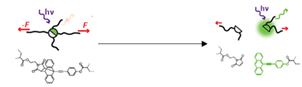
The material is a silica-filled styrene-butadiene rubber, a synthetic rubber used in tires, tagged with the mechanophore. The internship will focus on sliding friction wear tests. Macroscopic wear will be assessed through optical microscopy, friction force analysis, mass loss, and surface roughness measurements. Molecular damage will be mapped and quantified via confocal microscopy, with fluorescence indicating the extent of mechanophore bond breakage.
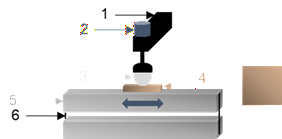 |
Metal bar Dead load Alumina bead Rubber Metal strips for tangential force recording Translation platform |
|---|
[1] Petitet et al. (2005). A Contribution to the Understanding of Elementary Wear Mechanisms of Rubber Filled Compounds. Rubber Chemistry And Technology, 78(2), 312-320.
[2] Persson et al. (2025). Rubber wear : Experiment and theory. The Journal Of Chemical Physics, 162(7).
[3] Slootman et al. (2020). Quantifying rate-and temperature-dependent molecular damage in elastomer fracture. Physical Review X, 10(4).
[4] Cartier et al. (2024). Labeling a polydiene elastomer with a π-extended mechanophore with a facile and low temperature synthetic route. Macromolecules.
[5] Taisne et al. (2026). Wear in multiple network elastomers arises from the continuous accumulation of molecular damage rather than microcrack growth. Science Advances, 12(18).

- Download the document